WorldSpace Direct Satellite Audio System Passes Initial Tests with Flying Colors

Erlangen, Germany. WorldSpace and Fraunhofer Institute for Integrated Circuits reached a milestone in the development of their direct satellite audio technology last week.

The next satellite generation of radio is driving toward reality. WorldSpace and the Fraunhofer Institutehave demonstrated that a satellite direct-to-person audio receiver with small efficient antennas works.

In experiments throughout September, at Fraunhofer’s laboratory in Erlangen, engineers used a helicopter equipped with a digital transmitter to simulate direct satellite transmission to prototype receivers in several environments. The tests demonstrated the WorldSpace system will send digital audio and multimedia signals directly to listeners who are driving in their cars, walking along the road or sitting in their homes.

“This demonstration proves that the WorldSpace system will work for people on the move throughout Africa, Asia, the Middle East, Latin America and the Caribbean,” said Noah A. Samara, Chairman and CEO of WorldSpace, after driving along streets and highways around Erlangen while listening to CD-quality sound being broadcast from the helicopter. “It was a wonderful trip.”

Beginning in mid-1998, WorldSpace plans to launch three geostationary satellites that will broadcast audio and multimedia programs to a potential audience of more than four billion people in Africa and the Middle East, Asia, and Latin America and the Caribbean. The system will offer hundreds of near-CD quality audio and multimedia channels to consumers equipped with personal, portable receivers.

The Fraunhofer Institute is a pioneer in digital audio broadcast. Their software engineers have developed a customized version of MPEG II Layer 3 digital compression which makes it possible for WorldSpace satellites to broadcast good quality audio transmission at rates as low as 16 kilobits per second. Further development and implementation tests of the WorldSpace system will continue in Erlangen over the next several months.
Waves Introduces StereoMaker Plug-in for ProTools/TDM Workstations

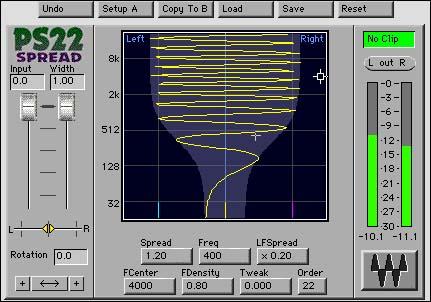
Knoxville, TN. Waves Ltd. is shipping a new addition to its family of DSP modules for the Digidesign TDM™ plug-ins, ProTools™ and Sound Designer II™ environments. The PS22 StereoMaker creates a rich stereo image from mono sources, and also enhances the spread of stereo sources.

According to Chad Bloch, Waves Technical Sales Manager for the West Coast, PS22 can be used to create greater space in a stereo mix, as well as to create stereo enhancement of mono recordings or single tracks in a mix.

“The primary purpose is to process a mono recording,” says Bloch. “But you get some really interesting results when you put a stereo mix through it. Individual instruments stay where they belong in the mix, but they sound more spacious, maybe more natural.”

PS22 is designed to avoid problems common with previous stereoization processes. Waves claims that it has virtually no unpleasant “phasiness,” very little coloration, high tonal accuracy, and good mono compatibility.

The Waves PS22 interface provides controls allowing adjustment of specific sounds to be anywhere in the stereo image. It also presents a graphical display of position as a function of frequency.

The PS22 module for the Digidesign DAE plug-in environment is available now at a list price of $1,169 (US). It is also available until November 30 at a special price of $919 (US) to owners of the Waves S1 plug-in for stereo-image manipulation. Future versions of PS22 will support Adobe’s Premiere, and Macromedia’s Deck II and SoundEdit 16.

Users Pleased With Performance of DSP-Assisted Hearing Aids

Cleveland, OH. Oticon Inc., developer of a recently-introduced digital hearing instrument called DigiFocus™, presented a forum here today at The Cleveland Clinic Foundation. Audiologists and researchers reported results of field testing by U.S. patients using DigiFocus.

Rreports and case studies presented at the forum underscored the flexibility of the individualized programming and the quality of the digital sound as potential benefits for a broad range of hearing impaired individuals.

“Every person has a unique hearing loss fingerprint,” explained Craig Newman, Ph.D., Head, Section of Audiology at The Cleveland Clinic Foundation. “Until now, conventional analog-based hearing instruments allowed sound manipulation in only two to three hearing bands. Digital signal manipulation enables us to adjust sound in seven bands and more than 100 software-controlled parameters. As a result, we can adjust the computer precisely to compensate for the individual’s hearing loss.”

The DigiFocus digital audio processor has computing power amounting to 14 million instructions per second. It automatically adjusts to changing sound environments, improving a user’s ability to hear speech clearly in settings that are traditionally challenging for individuals with hearing loss, such as restaurants and cars.

“To a properly fitted individual, the introduction of the technology can be compared to the transition from a simple radio with only bass and treble controls to the sophistication of a fully digitized recording studio with its ability to adjust sound frequencies in a myriad of ways to achieve listening pleasure,” noted Peter Mark, M.D., of Oticon.

Researchers Johan Hellgren and Thomas Lunner of Linkoping University in Sweden, an internationally recognized leader in hearing research, shared results of a recently completed study of 33 satisfied users of conventional analog hearing aids who were fitted with the new DigiFocus. The study showed that 80 percent preferred the digital hearing aid over their own instruments.

South Korean Manufacturer Will Make Listen Up Players

Cupertino, CA. Audio Highway announced today that it entered into a manufacturing agreement with with KIA of South Korea and Sycom Technologies of Ewing, NJ. KIA will make all hardware components of the Listen Up™ portable web audio system announced last week by Audio Highway. Sycom will assist in the final design and release of the Listen Up Player.

“Given their vast resources, we’re extremely pleased to be working with KIA and Sycom,” said Nathan Schulhof, Audio Highway President and CEO. “Sycom’s strength in the portable audio device market, coupled with KIA’s a vast resources in the consumer related products market, as well as being a major manufacturer of automobiles, makes this an unbeatable relationship.”

Under terms of the agreement, Audio Highway’s Listen Up Players will be available at more than 3,000 locations throughout North America, when the system is released in January 1997. Locations will include consumer electronics stores, computer dealers, office product outlets, specialty retailers and other retail superstores. Audio Highway will also sell the player direct to consumers at a suggested retail price of $299 through a toll free sales line.

Go-Video to Add QSound 3D Audio to Dual-Deck VCR’s

Calgary, Canada. QSound Labs and consumer electronics manufacturer Go-Video have signed a licensing deal that will allow Go-Video to incorporate QSound’s simulated-3D audio technology in its home theatre and high-end digital TV products.

“Combining QSound’s patented 3D audio technology with Go-Video’s flair for product development and marketing seemed a perfect match,” said Roger B. Hackett, Chairman and CEO of Go-Video. “Their professional studio experience provides us with an opportunity to enter the audio market with high-performance niche products, which are always very attractive to our retail customers.”

The first product to take advantage of the deal will likely be a new entry in Go-Video’s successful line of Dual-Deck™ videocassette recorders.